
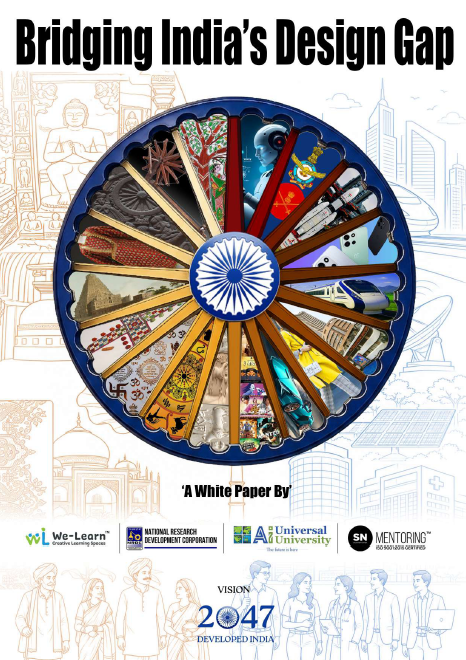
Bridging the Gap: Collaborative Roadmap Outlines India’s Path to Becoming a Global Design Superpower by 2047
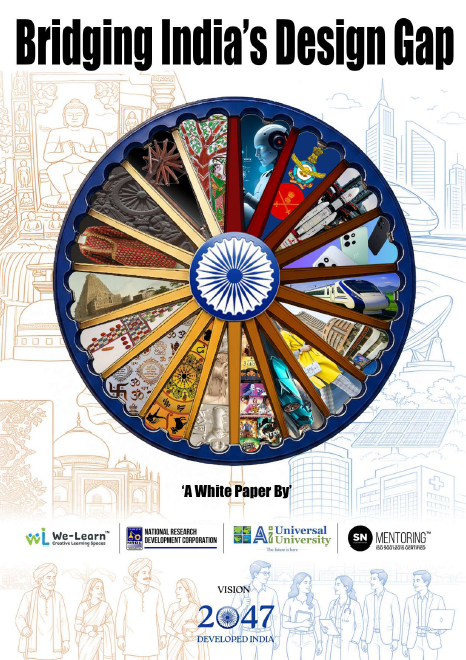
As India targets the ambitious vision of Viksit Bharat 2047, a strategic collaborative report titled "Bridging India’s Design Gap" has been released, providing a comprehensive framework to transform the nation’s innovation landscape. Developed by experts from We-Learn, SN Mentoring, Universal AI University, and the National Research Development Corporation (NRDC), the report argues that India must transition from a service-led "Make in India" model to an innovation-led "Design in India" economy to own the intellectual property of the future.
The report identifies a critical "Design Gap" a systemic disconnect where educational institutions prioritize rote memorization while industries demand systems thinking and user-centered innovation. A major concern highlighted is the "crisis of outsourced cognition," where students use Generative AI as a bypass for the intellectual friction required for growth, leading to a "competence bubble" that bursts in high-stakes professional environments.
Commodore (Retd.) Amit Rastogi, Chairman & Managing Director of NRDC, highlighted the institutional necessity of this shift: "NRDC shall strategically position itself as a national technology commercialization and innovation facilitation hub... The integrated ecosystem of Design Support, System Engineering, and Intellectual Property Facilitation can significantly contribute towards transforming research outcomes into commercially viable products". He noted that sustainable growth requires a future-oriented ecosystem backed by strong mentorship and creative thinking.
Addressing the need for educational reform, Mr. Tarun Anand, Founder & Chancellor of Universal AI University, emphasized moving away from static models. "The emphasis must be placed not on the amount of information students can collect, but on the skills they develop to think, adapt, collaborate, and innovate," Anand stated, adding that the goal is to integrate technology with human needs and logic with imagination.
The report proposes a K–12 transformation pioneered by We-Learn, shifting the learning culture from memorization to inquiry. Mrs. Neha Pandit, Founder & CEO of We-Learn, explained: "Design Education focuses on integrating creativity, engineering principles, sustainability and business thinking... [to equip] students with not just participating in the future, but also to designing it,". This approach treats failure as a data point in iterative learning rather than a source of punishment.
Nurturing this talent requires specific mentorship. Mr. Saurabh Nanda, Founder & CEO of SN Mentoring, framed design as an evolutionary operating system: "Our way of thinking is design. Design and art is how we have shared our knowledge... Today’s design languages and principles need to help entrepreneurs solve problems better... [and] unlock potential of our youth who are not being pushed into 20th century mechanical careers,". The report advocates for science-backed career guidance to identify creative problem-solvers who might otherwise be overlooked by traditional academic metrics.
Ultimately, the collaborators argue that bridging this gap is a "survival mandate". By integrating Design Thinking into the national education and research pipeline, India can develop a sovereign innovation workforce capable of leading the multi-trillion deep-tech and human sectors by 2047.
Please download the paper from here - Click Here to Download
Beta Version
Copyright © 2023. NRDC - All Rights Reserved
Designed and Developed by Maxtra Technologies.


